
The Infrastructure You Never Think About
Armed with a thick puffer coat and a hard hat, I gaped at a cluster of eight 145 feet tall by 80 feet wide oval structures clad in steel. The guide affectionately called them “eggs” but to me, they looked like balloons in the process of getting blown up. This was not a large-scale art installation—I was in New York City’s Newtown Creek Wastewater Resource Recovery Facility (WRRF) and these structures, properly named biodigesters, process 250 million gallons of wastewater (nearly 1 billion litres) and 220 tons of organic food waste a day. It is one of the city’s 14 WRRFs and certainly its most iconic. As I walked around and listened to the guide explain how the facility functions, I was part awestruck and part thankful that we could not smell the unspeakable from New York’s finest. After wastewater and stormwater runoff travel from toilets and storm drains to the facility, they go through a multi-step treatment plan that involves screening, settling, disinfection and my favorite, microorganism tending. In this step, the facility adds air to the aeration tanks for the oxygen-loving microorganisms that are naturally present in the sewage. They consume the organic material in this wastewater which yields heavier particles that are easier to remove. Later, in the biodigester, a different set of microorganisms are given a toasty 98°F (36.7ºC) low-oxygen environment so they can digest the sludge produced in previous steps and convert it into biogas. These bacteria are crucial team members and through the way that the NYC Department of Environmental Protection (DEP), the agency that manages the facility, carefully monitors them in the laboratory to ensure they are in proper balance, it was clear that our city would be in deep trouble without this collaboration between humans, other living organisms and technology. Furthermore, the biogas produced is used to power the facility’s operations as well as injected into National Grid’s local distribution grid to heat over 7,000 homes in Brooklyn.
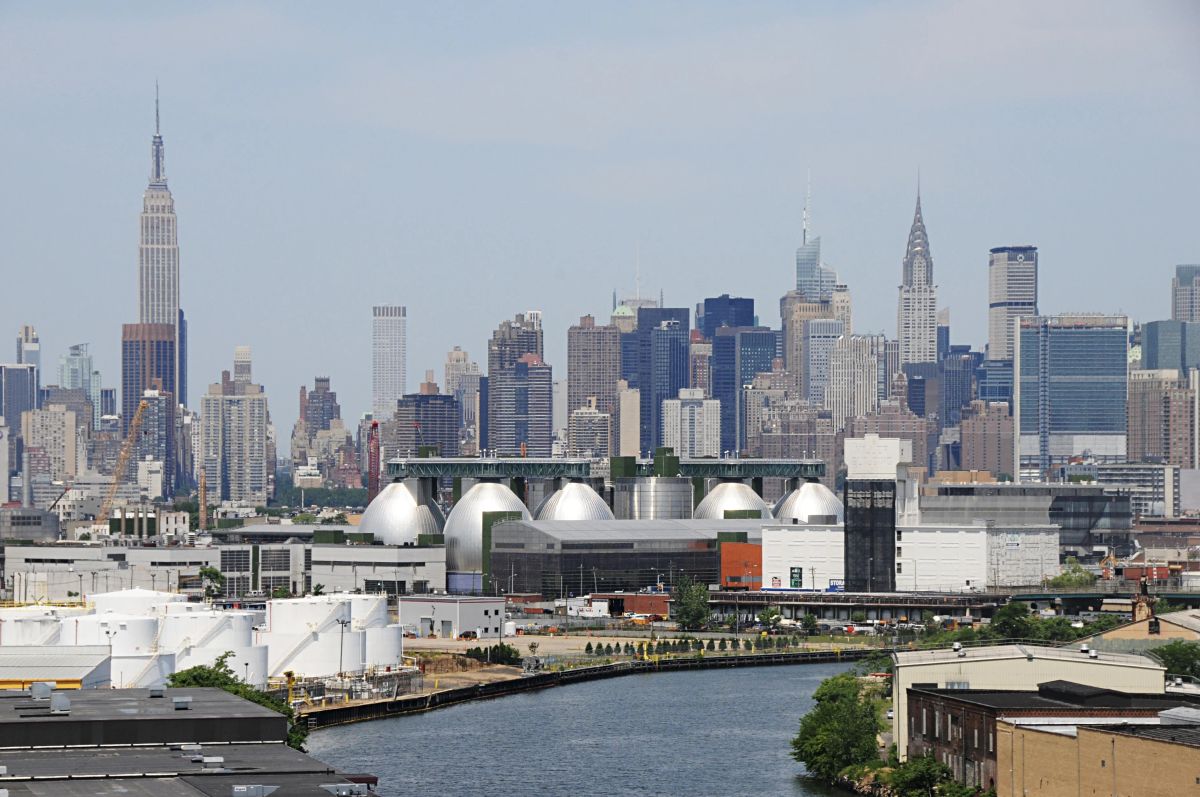
The 'eggs' in New York City’s Newtown Creek Wastewater Resource Recovery Facility. Image by NYC Water. All rights reserved.
There are other kinds of partnership necessary to provide water services to one of the biggest cities in the world. Starting from the source, we have 19 reservoirs and 3 controlled lakes that provide 1.1 billion gallons of water (roughly 4 billion litres) on a daily basis. This water flows from various parts of Upstate New York down to the city. 97% of the water gets delivered through gravity alone. It takes less effort for the water to travel nearly 100 miles (161 km) from the Catskill to my first Manhattan apartment than it did for me to climb the 5 flights of stairs to get home. This marvel of engineering would impress anyone but what truly shocked me was the fact that most of the water is not filtered. In fact, it is the largest unfiltered municipal water supply system in the world. To achieve this, DEP must ensure that the water meets all quality standards by addressing sediment problems and algae blooms. Since 1997, DEP has worked with upstate communities through partnerships with locally-based not-for-profit corporations the Watershed Agricultural Council and the Caskill Watershed Corporation to protect the ecosystem around the watersheds. From buying out land to prevent development, upgrading wastewater and sewage plants, managing streams to prevent erosion to helping farmers and foresters implement management practices that minimize the impact on the watersheds. Now these all sound like programs that would benefit New York City and its goal for pristine water. But as relational creatures, we understand that all good relationships are mutually beneficial. Beyond the US$100 million paid in annual real estate taxes, DEP funds local economic development initiatives to provide business loans and grants, procures goods and services from local vendors, employs hundreds of people in and near the watersheds, and provides recreational access to the water and lands.
I first learned of this at a public talk where hundreds of other water nerds and I furiously took notes in between the oohs and ahs at every fact presented. The talk was part of a series by Open House New York to give curious residents an inside view into the infrastructure holding up our city, weaving into a larger mission to promote a deeper understanding of how the city functions. I had another motivation to attend the event—I had just joined DEP a few months earlier as an Urban Innovation Fellow and was absorbing every piece of information that would help me understand how to deploy digital solutions to advance the agency’s mission to protect public health and the environment. Learning the agency’s history was the first step. This reconnection with history is common practice for those who work in urban contexts - urban planning, policy, or physical infrastructure development - but uniquely refreshing for technologists like myself who up until that point had spent my career in private tech obsessing over the future and its possibilities. Ivan Zhao, the co-founder of Notion, a productivity app serving over half of the Fortune 500 companies, declared history an undervalued resource for those in tech. As I sat in the audience, I was searching for elements that made DEP successful in the past and lessons I could replicate for its contemporary goals. It wasn’t the mere accessibility to top-of-class technology of the times, it was how they implemented it to create real benefits.

Image by Elsa Gonzalez on Unsplash
The hidden power of life-changing innovation—collaboration
Joseph Schumpeter, the 20th century economist who popularized the term “innovation”, drew a distinction between an inventor, someone who discovers new methods and materials, and an innovator, someone who applies those new discoveries to often highly resistant markets and creates value. Take the discovery of penicillin. Sir Alexander Fleming identified this bacteria-killing substance in 1928 after a summer holiday when he came back to his lab at St Mary’s Hospital medical school to find that mold had destroyed his bacteria cultures and studied said mold. This miracle of a discovery is responsible for reducing mortality rates worldwide and enabled high-risk procedures like organ transplants and cancer chemotherapy. You would think the world embraced it, thanked Fleming and reaped the benefits immediately. He did end up getting a Nobel Prize in 1945. Two years after penicillin came into widespread use and 17 years after his discovery. It took more than a lone brilliant scientist to change the world. Fleming’s two co-awardees, University of Oxford’s Ernst Boris Chain and Sir Howard Walter Florey, discovered his paper a decade after it was published. They found a way to isolate and produce penicillin quantity then ran experiments that showed extraordinary results. This was another breakthrough but we were still not at the end of the story. The two researchers lacked capacity to manufacture the substance in mass quantities. The Rockefeller Foundation stepped in to provide funding to further develop the methods that allow for large-scale production. When the United States entered World War II, federal authorities recognized an urgent need to ramp up medical supply chains. By 1943, the War Production Board had coordinated a consortium of 21 manufacturers to mass-produce penicillin, transforming what had been a laboratory curiosity into a battlefield necessity and, in doing so, launching the modern age of antibiotics.
Even though this is the second bacteria story I’ve cited, I am less fascinated with them than I am with the hidden power of life-changing innovation—collaboration. The partnerships in the penicillin story involve healthcare, academia, philanthropy, government, and private companies. Nowhere else is the value of these relationships more apparent than in urban ecosystems, where innovators can also partner directly with the communities they aim to serve.

Images by Taylor Heery and Wolfgang Rottmann on Unsplash
Partnerships in the City
In 2018, the City of Detroit government partnered with a coalition of automotive manufacturers, energy utilities, real estate developers and philanthropic organizations alongside BCG Consulting on a 12-week sprint to redesign urban mobility, gathering input from residents before narrowing 120 ideas to six pilots. 51% of working Detroiters cite access to a car as a top employment barrier, in a city where average annual car insurance premiums were the highest in the country. Pilots directly targeted this gap: Car4You gave residents US$7/hour vehicle access for job interviews and medical appointments, MicroTransit ran demand-responsive shuttles with fewer stops to cut commute times, and ChargeD built EV fast-charging infrastructure in public parks. The sprint also institutionalized Detroit's Office of Mobility Innovation as a standing city function, which later launched a free autonomous shuttle program specifically for residents over 65 and people with disabilities.
In the early 1990s, South Korea's primary landfills reached capacity, forcing a national rethink of waste policy. The Seoul Metropolitan Government led the response, partnering with civic organizations, community monitoring groups, and private technology manufacturers. The government banned food waste from landfills entirely in 2005 and introduced RFID-based weighing bins in the early 2010s, billing households monthly based directly on the weight of their output. In 2025, Seoul extended the system with a points program rewarding households that cut their output further with credits redeemable for tax payments, utility bills, and local gift certificates. Seoul's RFID bins alone reduced food waste in the city by 47,000 tonnes in six years, with South Korea's national recycling rate rising from 2% in 1995 to 95% in 2025.
The oyster did not evolve to clean the Chesapeake Bay for human benefit. It evolved to feed itself, filtering up to 50 gallons (189 litres) of water a day as a byproduct of its own survival. For thousands of years, the Bay's vast reefs kept the entire estuary in balance. Then came overharvesting, disease and runoff. By the late twentieth century, only 1 to 2 percent of the historic native oyster population remained. What followed was one of the most unlikely coalitions in American environmental history: NOAA supplied funds and monitoring, the Army Corps of Engineers built reef foundations from stone and shell, the University of Maryland's Horn Point Laboratory produced billions of juvenile oysters, and nonprofits including the Chesapeake Bay Foundation distributed them throughout the underwater sanctuaries — alongside the Maryland Watermen's Association, the commercial fishermen who had historically harvested oysters for a living. By 2025, partners had planted approximately 7.5 billion oysters across 2,400 acres (970 ha) of restored reef habitat in 10 tributaries. It became the world's largest oyster reef restoration project. Cleaner water is not only an ecological outcome. It supports the blue crab fishery, reduces algal blooms that close swimming beaches, and protects the drinking water and coastal economies of millions of people across Maryland and Virginia who never once thought about an oyster.
Back in New York, our own waterways have grown cleaner too, the product of grassroots projects like the Billion Oyster Project, the federal Clean Water Act, and DEP's decades of investment in gray and green infrastructure. From the Cornell Tech campus, where I convene with other Urban Innovation Fellows once a week, I look out at the East River hoping to catch sight of the dolphins that have made their way back, drawn by fish that could not have survived there a generation ago. My fellowship feels like its own small emblem of collaborative innovation. Funded by Bloomberg Philanthropies, it takes mid-career professionals, mostly from the private sector, and embeds us inside government agencies, hosted at Cornell Tech, the applied science graduate campus of Cornell University where research in urban and health tech is happening down the hall. Everyday we work with our agencies, startups and other partners in the innovation ecosystem to apply new technologies and practices that can make life better for New Yorkers, whether that means protecting them from air pollution and stormwater, managing the infrastructure under their feet and under the water, or decarbonizing the assets the whole city runs on.
My favorite activity in any city is watching its inhabitants interact with one another. Jane Jacobs said that cities are ecosystems, not metaphorically, but structurally, governed by the same principles as living systems: diversity, feedback, and co-development. What makes them work is not any single actor or technology, but the relationships too numerous and too intricate to fully see. ●
Related Articles

Beyond Books and Shelves: Four Cities Reimagining the Public Library — and Public Life
«Urban sketching is a form of love towards the city, to things that are not perfect»
.jpg?w=1000&q=80&fit=max&auto=format)
What's New at the New CitiesToBe?