
Data-driven cities bring benefits and vulnerabilities
As cities grow denser, the question is no longer whether technology will shape urban life, but how. The Internet of Things is not just an add-on; it offers practical responses to some of the most pressing challenges cities face today: congestion, mobility, and the efficient movement of people.
Yet a data-driven city is not only about sensors and signals. It also demands a deeper conversation about security, individual privacy, and equity — about who benefits, who is protected, and who might be left behind.
In this interview, Jeff Merritt, Head of Urban Transformation and Member of the Executive Committee at the World Economic Forum (and former Director of Innovation for the City of New York), reflects on how technology, when thoughtfully implemented, can make cities more livable, efficient, and inclusive.
Cities are where people come together; they are a magical place. It’s not a surprise that we are seeing a massive move toward cities because when people come together, you create communities and efficiencies. You also have the ability to improve quality of life in ways that would otherwise be impossible.
When you bring people together, it’s not a surprise that we see densification. That is both our strength and our weakness, as it creates many problems when we think about congestion and how we move people in a more efficient way. This is why smart cities and these technologies are such important enablers; they can help us find efficiencies and make cities more liveable. Otherwise, the number of people we are packing into small areas becomes chaos. Technology helps us organize this chaos, find efficiency, and improve quality of life.
When we think about the challenges we face, living in a more data-driven world means we also have to think more about security and privacy. On the one hand, this technology can bring us great benefits; however, it can also be abused, creating new vulnerabilities and threats. So we have to make sure we are thinking carefully about this: if we are transforming our cities to be data-driven, how are we protecting this data and individual privacy? And how are we looking out not only for the wealthiest or those with the greatest opportunities, but also for those who are, in some ways, left out or marginalized?
We have to put a real emphasis on equity and on those who, due to their history of marginalization, have lost trust in governments, institutions, and corporations. If we are not focusing on those individuals and communities, we are creating a divide in our cities that, in the end, becomes a divide in our entire society.
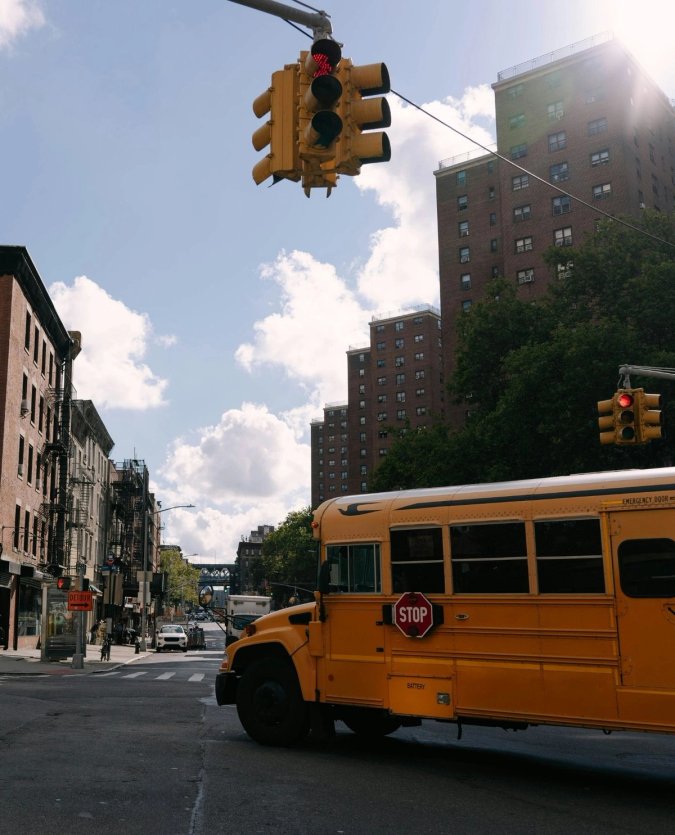
One favorite example that shows how technology can truly improve life is how we are using IoT to prioritize buses. Bus transportation is one of the most efficient ways to move people from point A to point B. The question is: how do we encourage and incentivize people to take the bus instead of driving their own car?
One of the ways we have been able to do this in New York is by prioritizing buses at intersections, enabling them to move through traffic faster. How does this work? Technologically, it starts by enabling the bus to be a “smart bus” so it can communicate its location. You put a GPS sensor on a bus, and it becomes a smart bus. This already has value in itself: we can see where the bus is and whether it’s running on time.
In parallel, in New York we are making our traffic signals wireless. That, again, is a tremendous efficiency — being able to control a traffic signal remotely. When you connect these two pieces of technology, you have a smart bus that can communicate with a smart signal. That’s where the real magic happens.
The bus can signal its location to the traffic light, turning it from red to green as it approaches, or ensuring it stays green a little longer. This dramatically speeds up bus travel. We have seen a 20% reduction in commuter times as a result of this relatively simple technological enhancement.
In New York, we are now expanding this citywide. Enabling buses to be more efficient helps individuals make a conscious choice to use public transport because it becomes more convenient. These are the kinds of solutions that address concerns about increased congestion and densification, while making sure all New Yorkers benefit.
One of the things we need to remember about cities is that we move to them because of community. As humans, we are social beings, and you cannot have community that is void of art and culture. Otherwise, it becomes a technological future that none of us wants to live in.
Art helps us create balance; it serves as a counterpoint to technology. I encourage everyone to walk into their local museum, explore modern art, and constantly push themselves to see things from different angles, and to remember that this kind of beauty exists in life.