
5 Things Cities Must Rethink to Survive Extreme Heat
Sleeping? Nearly impossible. Walking? Intolerable. Going to the beach? Not even an option—it’s too hot to leave the comfort of home.
June 2025 was the hottest month ever recorded in Spain, offering just a glimpse of daily life in cities like Barcelona, Huelva and Murcia, where temperatures exceptionally soared past 40 ºC—weeks before summer usually reaches its peak. The same phenomenon affected France, Italy and Greece, where major cities such as Marseille and Athens saw record-breaking temperatures.
This isn’t normal. In the Northern Hemisphere, the hottest stretch of the year—known as the canícula in Spain—typically falls between mid-July and mid-August. However, what’s most alarming is how this abnormality is rapidly becoming ‘the new normal’. Every year, we seem to relive the same headline: “the hottest year on record.”
A new, hot, and uncomfortable urban normal
For cities, the consequences are real—and dangerous. Urban materials like concrete, asphalt, and brick absorb and retain heat. The result? Scorching nights, unbearable days and short walks that feel like marathons.
On top of that, extreme heat increases ground-level ozone, aggravating asthma, driving up respiratory illnesses, and even contributing to cardiovascular and autoimmune conditions. Spain’s national mortality monitoring system recorded nearly 100 heat-related deaths between June 1 and 21 alone.
Extreme heat is no longer a seasonal disruption. It’s a structural challenge.
This isn’t just a southern European problem. Here in the Mediterranean, we may be feeling the brunt of it—but cities across the continent are heating up. In the UK, temperatures have already hit 33 ºC this year.
At this point, it’s clear: extreme heat is no longer a seasonal disruption. It’s a structural challenge—one that’s forcing cities to rethink how they’re designed, managed, and experienced.
With nearly 15 years of experience working with urban systems, we’ve identified five essential shifts that every city—regardless of geography—must urgently make. These aren’t short-term solutions. They’re long-term, systemic changes.
1 | Stop cities from absorbing so much heat
Urban heat islands make heat waves worse. When cities are packed with dark surfaces—like asphalt, concrete, and rooftops—they absorb sunlight during the day and release it slowly at night. That can raise local temperatures by 5 to 10 ºC. Add pollution from traffic and industry, and the result is a hotter, more polluted city with lower quality of life.
One proven fix? Use high-albedo materials. Surfaces with a high solar reflectance—like cool pavements—bounce sunlight away instead of storing it. The higher the albedo, the more radiation gets reflected. A material with an albedo of 0.3, for example, reflects 30% of incoming solar energy. It’s passive cooling that helps keep entire neighborhoods more livable.
2 | Plant smarter — not just more
Green spaces aren’t just nice—they’re cooling systems. Parks, trees, and open spaces help cities breathe. They boost natural ventilation and lower temperatures, especially during heat waves. And thanks to satellite imagery, sensors, and data analysis, we now know which tree species offer the most shade—and where planting them will have the biggest impact.
But there’s a global gap. A recent NASA study found that cities in the Global South—like many in Latin America, Africa, and Asia—have far fewer green spaces than cities in the Global North. That means they can only achieve about 70% of the cooling effect through vegetation compared to their northern counterparts. In a warming world, that disparity matters.
Image by Agustín Farías on Death to Stock
Image by Brett Danielson on Death to Stock

Image by Daniel Farò on Death to Stock
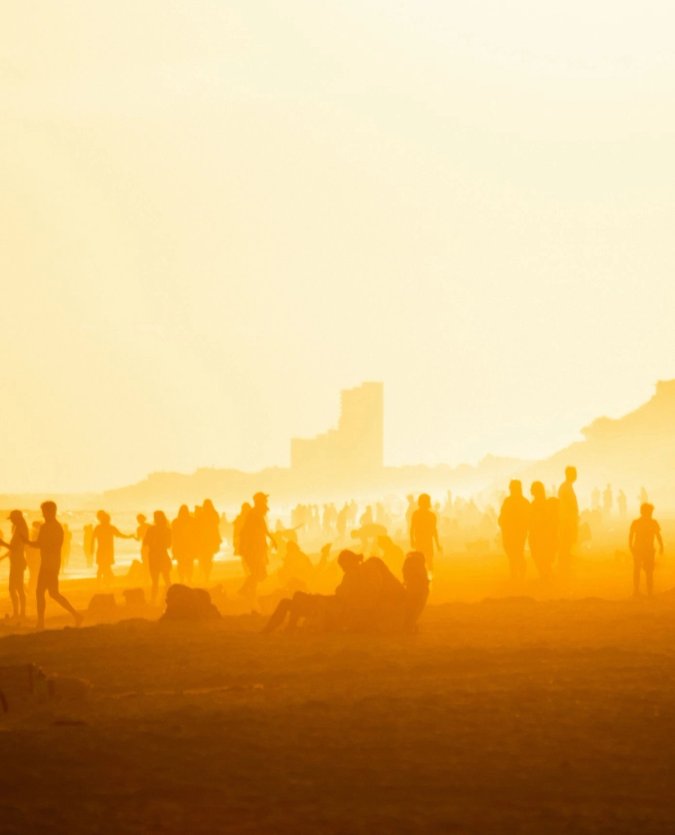
Image by William Rudolph on Unsplash
3 | Treat climate shelters as a city-wide network
Shelters that offer relief during extreme heat are gaining traction—but many still function as isolated spaces. What’s needed is a connected network.
Think: shaded parks, libraries, air-conditioned public buildings, and even underground spaces—all linked to allow people to move through the city in relative comfort, even during heatwaves. Cities like Barcelona, Bilbao and Vitoria have started to implement this approach—and they’re expanding it.
We also believe that extending the hours of public facilities like libraries, museums, and sports centers during heatwaves can make a real difference—so long as it’s balanced with energy efficiency and noise management.
4 | Break down silos — heat affects everything and must be managed holistically
Extreme heat isn’t just an environmental issue. It touches nearly every aspect of city life: health, transport, housing, energy use, public space.
That’s why we advocate for cross-cutting climate governance. Cities need to weave climate resilience into every department—from urban planning to social services. A good example comes from the Andalusian regional government, which created an interdepartmental climate commission to make sure resilience is factored into all policy decisions.
This is climate policy, yes—but it’s also public health policy, housing policy, and equity policy.

Image by Mick de Paola on Unsplash
5 | Put thermal justice at the center
Heat doesn’t affect all neighborhoods equally. Densely built areas with poor insulation and little greenery heat up more—and the people who live there are often the most vulnerable.
In Spain alone, more than 4 million people can’t afford to keep their homes cool during summer. That’s why we believe thermal equity must be a guiding principle: access to shade, airflow, and comfortable indoor temperatures should be a basic urban right—not a luxury.
Cities that are truly climate-resilient are cities that protect those who are most at risk.
In short: it's all about structural transformation
In short: we can’t afford to treat heat like an occasional anomaly. It’s here, it’s intensifying, and it’s changing how cities need to operate. The only real answer is structural: we need to redesign our urban environments, rethink how we govern them, and invest in public services that can cope with the reality of a much hotter future. ●